Hungarian elections explained III.
Political Campaigning and the Media Environment in Hungary:
Historical Background, Current Landscape, EU Reactions, and the 2026 Elections
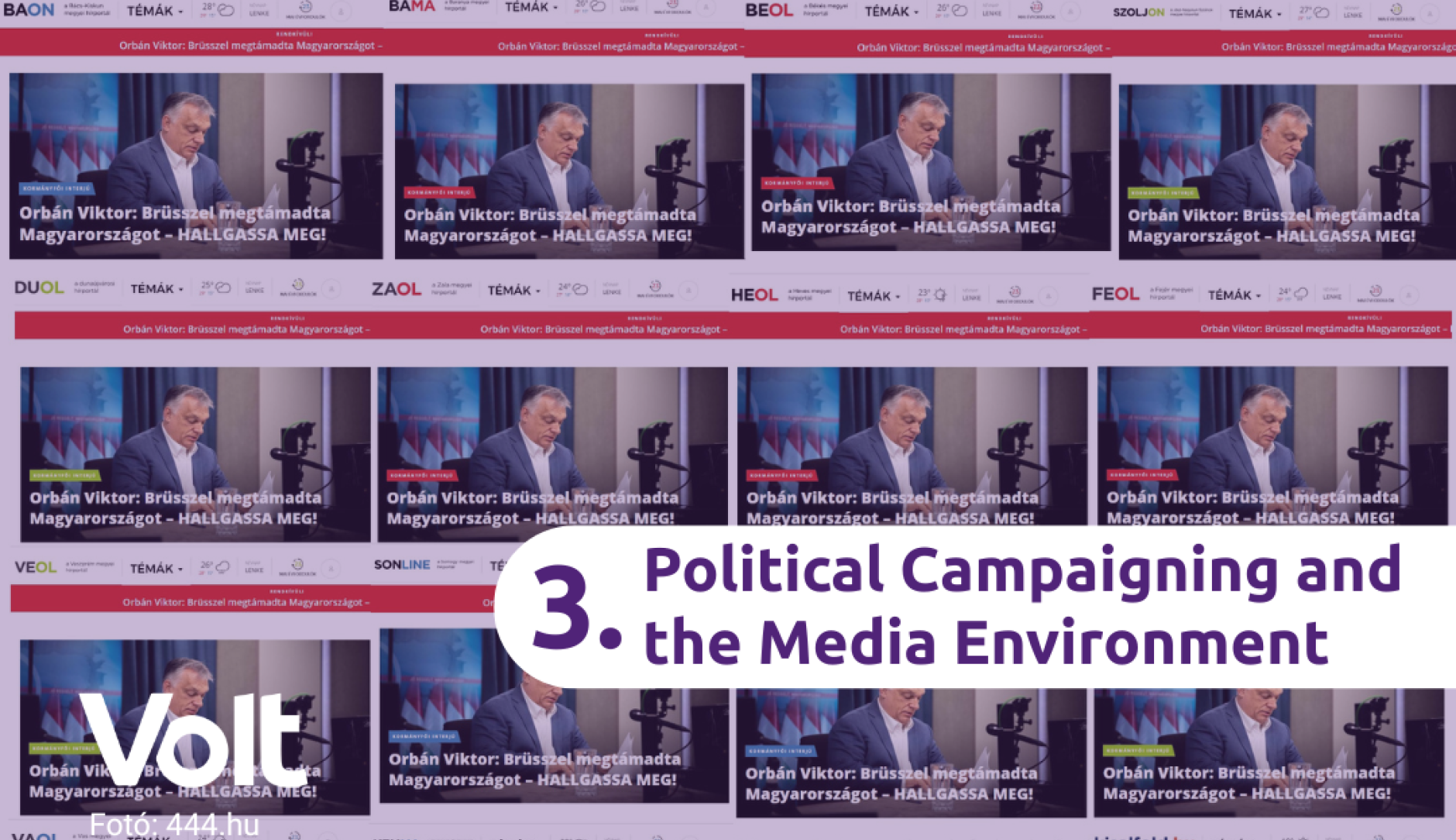
In this article, we present the distorted, asymmetric media environment in Hungary. The use of media in political campaigns. As well as its significance in the 2026 elections.
1. Introduction
Hungary’s political campaigning and media environment have undergone a profound transformation over the past decade and a half. While elections remain formally competitive, the information ecosystem in which political competition takes place has become increasingly asymmetric. This document provides an integrated overview of:
the historical evolution of media and political campaigning in Hungary,
the current media landscape and its relationship with the governing party Fidesz,
the structural disadvantages faced by opposition actors,
the reactions and interventions of the European Union,
comparative insights from Central Europe, and
extreme and illustrative examples that highlight systemic patterns.
The analysis is particularly relevant in the context of the 2026 parliamentary elections, which are widely regarded as a critical test of Hungary’s democratic resilience.
2. Historical Development of the Media–Politics Relationship
2.1 Pre-2010 Media Pluralism
Before 2010, Hungary’s media environment was broadly pluralistic. Public and private outlets reflected a range of political viewpoints, and while political influence over public broadcasting existed, it was constrained by legal safeguards, market competition, and a relatively strong journalistic culture. Hungary was generally classified as a “free” media environment by international monitoring organizations.
2.2 Post-2010 Structural Transformation
Following the 2010 election victory of Fidesz and the establishment of a two-thirds parliamentary majority, the media system entered a period of systemic restructuring. Legislative changes reshaped media regulation, oversight bodies were centralized, and new ownership patterns emerged. Over time, this resulted in the gradual alignment of large parts of the media sector with government narratives.
A defining moment in this process was the consolidation of numerous outlets into the Central European Press and Media Foundation (KESMA), which brought a significant share of Hungary’s print, online, radio, and television media under a single, pro-government umbrella. This consolidation fundamentally altered the balance between government-aligned and independent media.
3. The Current Media Landscape (2025–2026)
3.1 Public and Pro-Government Media
Public service media and a wide network of privately owned but government-aligned outlets form the core of the pro-Fidesz media ecosystem. These outlets benefit from:
preferential access to state advertising,
favorable regulatory treatment, and
coordinated messaging across platforms.
In practice, public broadcasters function as amplifiers of government communication, especially during election periods, with limited space for opposition perspectives.
3.2 Independent and Opposition Media
Independent journalism continues to exist but operates under persistent financial, legal, and political pressure. Many outlets rely on subscriptions, donations, or foreign grants, making them vulnerable to accusations of “external influence.” Their reach is strongest in urban areas and among younger, digitally literate audiences.
Digital platforms—particularly YouTube, podcasts, and social media—have become essential channels for alternative political discourse. However, their overall impact is constrained by algorithmic reach, resource asymmetries, and the continued dominance of television and regional print media in rural areas.
3.3 Digital Campaigning and Online Influence
Online political advertising and influencer activity are characterized by significant asymmetry. Pro-government actors consistently outspend opposition parties and benefit from loosely coordinated networks of supportive influencers, NGOs, and media pages that reinforce government narratives without formally identifying as party campaign tools.
4. Political Campaigning: Fidesz and the Opposition
4.1 Fidesz Campaigning Strategy
Fidesz’s campaigning relies on centralized message discipline and long-term narrative framing. Core themes typically include:
national sovereignty and resistance to external pressure,
security and stability, particularly in relation to war and migration,
economic continuity and protection of households.
The distinction between state communication and party campaigning is often blurred, with government information campaigns closely mirroring party messages. This provides the governing party with a permanent campaign advantage, extending well beyond official campaign periods.
4.2 Opposition Campaigning Dynamics
Opposition parties have historically been weakened by fragmentation and limited media access. In recent years, however, political realignment—most notably around new political formations—has reshaped the opposition landscape and increased electoral competitiveness.
Despite this, opposition actors face systemic disadvantages:
minimal access to public broadcasters,
hostile framing in pro-government outlets,
reliance on digital and independent media with uneven national reach.
Campaign strategies therefore emphasize direct voter engagement, social media mobilization, and appearances in independent online platforms rather than traditional mass media.
5. Extreme and Illustrative Examples
Several patterns illustrate the depth of media capture and campaign asymmetry:
Smear campaigns and delegitimization of journalists and opposition figures through coordinated media attacks, often portraying critics as foreign agents or national security risks.
Market distortion through the concentration of state advertising in government-aligned outlets, undermining the financial sustainability of independent media.
Regulatory pressure, including fines or investigations targeting critical outlets, while comparable practices by pro-government media go unpunished.
Information exclusion, particularly in rural regions, where voters may have near-exclusive access to pro-government media sources.
These examples are not isolated incidents but reflect systemic incentives embedded in the current media and political framework.
6. Reactions from the European Union
The media environment in Hungary has triggered sustained concern from the European Union. The European Commission has repeatedly identified media pluralism, ownership concentration, and state advertising practices as structural risks in its annual Rule of Law Reports. It emphasizes that the existence of independent online outlets does not offset the dominance of pro-government media in broadcast and regional markets.
The European Parliament has adopted a more explicit political stance, passing resolutions that describe Hungary as an “electoral autocracy” and explicitly linking media capture to unfair electoral competition.
These concerns have had tangible consequences. Under the EU’s conditionality framework, significant funds have been withheld from Hungary due to persistent rule-of-law deficiencies, of which media freedom forms a critical component. Hungarian authorities dispute these assessments, but EU institutions consistently argue that structural dominance, not formal plurality, is the decisive issue.
7. Comparative Perspective within Central Europe
Compared with other Central European states, Hungary represents a distinct and more centralized model of media–politics integration.
In Poland, political influence over public media increased under previous governments but remained counterbalanced by a diverse private media sector and subsequent political change.
Slovakia shows growing pressure on public media, yet lacks Hungary’s level of ownership consolidation.
The Czech Republic retains comparatively strong media pluralism and weaker links between state advertising and political loyalty.
Hungary stands out due to the scale of consolidation, integration of state resources into political messaging, and direct electoral use of media dominance.
8. Legal and Institutional Framework at EU Level
The EU has deployed multiple mechanisms in response to developments in Hungary:
Article 7 proceedings, highlighting systemic risks to EU values.
Rule of Law Conditionality, linking funding to governance standards, including media independence.
Judgments of the Court of Justice of the European Union, which have upheld the legality of conditionality mechanisms.
Repeated assessments by the OSCE Office for Democratic Institutions and Human Rights, documenting unequal media access and blurred boundaries between state and party campaigning.
Many recommendations from these bodies remain unimplemented.
9. The 2026 Parliamentary Elections: Context and Outlook
The 2026 elections are widely viewed as one of the most consequential in Hungary’s post-2010 history. While voter choice formally exists, the broader concern lies in the informational environment shaping that choice.
Key risks include:
continued dominance of pro-government media narratives,
unequal access to mass media during the campaign,
further polarization of political discourse
+ online Russian disinformation campaigns to help Orbán’s reelection.
From both domestic and European perspectives, the central question is no longer whether elections are held, but whether voters can make informed choices under conditions of genuine media pluralism.
10. Conclusion
Hungary’s political campaigning and media environment are best understood as a structurally integrated system rather than a collection of isolated irregularities. Media ownership concentration, state-aligned messaging, and asymmetric campaign access jointly shape electoral competition.
As the 2026 elections approach, Hungary remains a focal point in the European debate on democratic standards, media freedom, and the limits of political divergence within the EU. The outcome will not only determine domestic political power, but will also influence Hungary’s long-term relationship with European institutions and democratic norms.